Emergency Garage Door Repair Near Me: What Chesapeake Homeowners Should Do First
Leaving a broken garage door half-open is the worst thing you can do. That position puts maximum stress on a compromised spring or cable, and it leaves your home visibly unsecured to anyone driving past. The first thing to do is get the door to a stable position – fully closed or fully open – without forcing it. That takes a few careful minutes, and it’s usually the difference between a straightforward garage door repair and a much bigger job. If you’d rather not touch it, call (877) 745-2212 and we’ll talk you through it.
What Should You Do in the First Few Minutes After a Garage Door Fails?
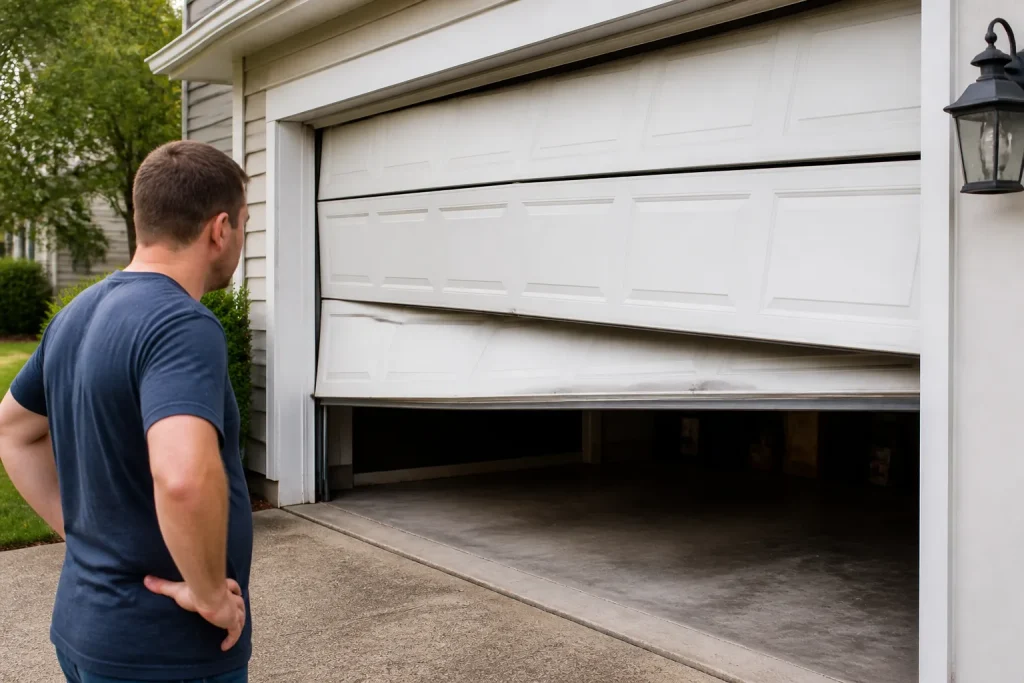
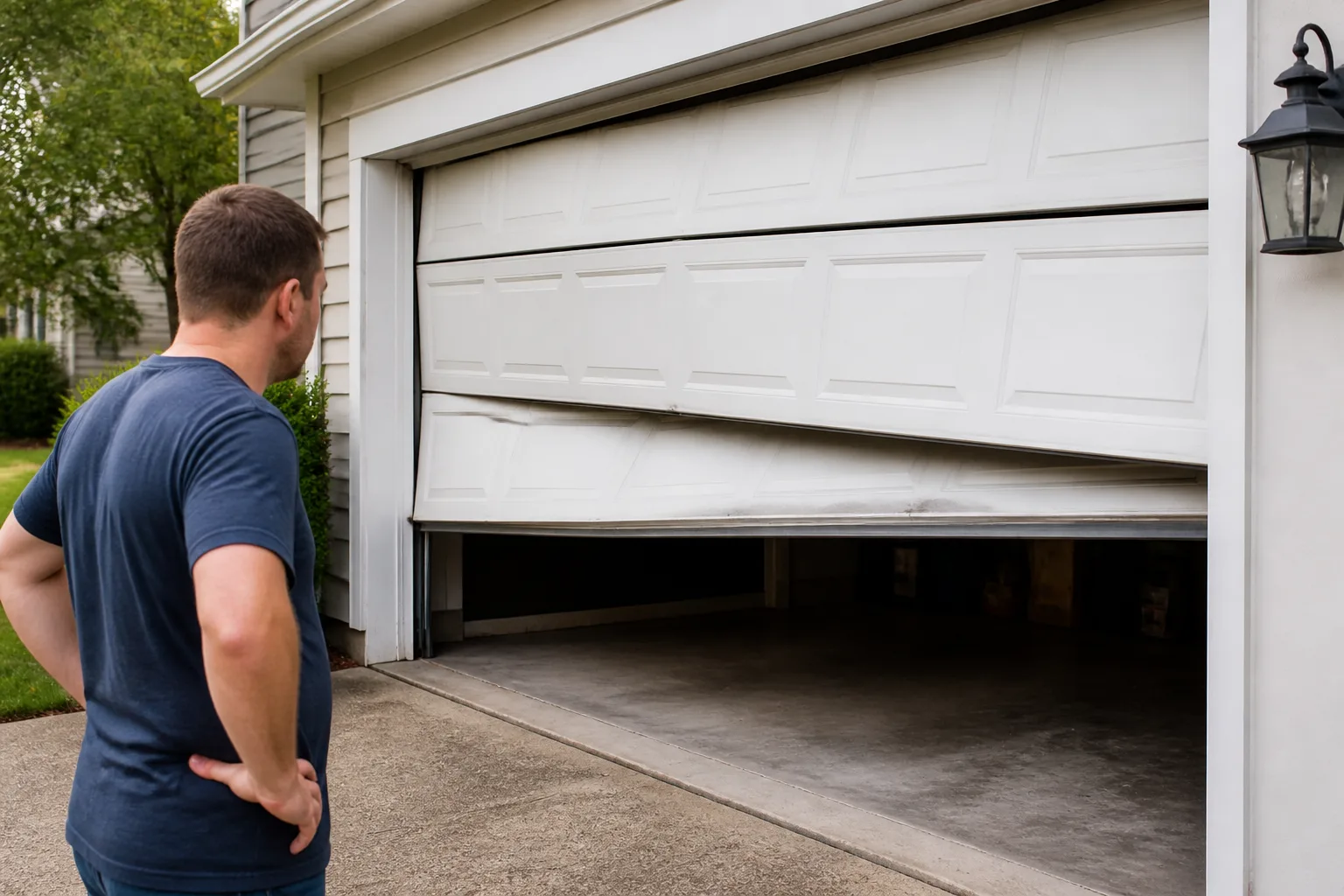
Stop operating the door and make it stable. Don’t keep pressing the remote hoping it catches. A door that’s binding, hanging crooked, or resting on one cable will keep getting worse with every cycle, and the parts under load don’t warn you before they let go.
Here’s how we walk Chesapeake homeowners through those first minutes, in order:
- Step back and look at the door. Is it crooked, hanging lower on one side, or off one of its tracks? Note where it failed before you do anything else.
- Decide which stable position is reachable. If the door is a few inches open and moves freely, ease it down and close it by hand. If it’s already up and won’t budge, leave it fully open rather than dragging it partway down. A door parked at the halfway point is the one that damages panels, bends tracks, and puts the most strain on whatever is already failing.
- Disconnect the opener before you touch the door by hand. Pull the release cord so the trolley disconnects from the carriage. That way the opener can’t suddenly engage while your hands are in the mechanism.
If the door won’t hold a position, or it feels heavier than it should, stop. That weight tells you the spring or cable is compromised, and no amount of muscle makes that safe. Close the door if you can, prop or block it if you can’t, and call.
How Do You Secure an Open or Unlocked Garage Door While You Wait?
Treat every open door as an open door to your house, because that’s what it is. Your priority while you wait for a technician is to close off access – not to make the door work again.
- Lock the interior door into the house. If there’s a deadbolt or a locking knob between your garage and your living space, use it. That’s your real security line.
- Block the door opening. A vehicle parked across the opening, a heavy piece of furniture, or a couple of sturdy boards wedged against the inside of the door all discourage someone from wandering in.
- If the door is up but won’t latch, tie it off. Use rope or a ratchet strap from the door’s bottom edge to something solid to stop it from dropping or swinging. Never stand underneath an unsupported door to do this – reach from the side and keep your body clear.
- Turn on the garage and exterior lights. If your opener has a manual lock feature, engage it so a stray remote signal can’t move the door while it’s tied or blocked.
Chesapeake homes often have the garage door as the most-used entrance, so a door stuck open overnight is a real concern rather than a minor one. Getting it shut or blocked before dark matters more than getting it fixed before dark. We handle Garage Door Repair Chesapeake Pros emergency calls for exactly these situations, and we’ll ask you about security first when you call.
What Should You Never Touch on a Broken Garage Door?
Never touch a broken spring or a frayed cable. Both are under heavy tension, and a failure releases that stored energy in an instant. This is the part of a garage door that genuinely injures people, and it happens in seconds.
The physical reason is simple: the springs carry the door’s weight so the opener doesn’t have to. A torsion spring on a standard residential door can be holding hundreds of pounds of force, and a tensioned extension spring is much the same idea along the ceiling. When a spring snaps or a cable frays, that force has to go somewhere, and it goes wherever the cable or spring end travels. A winding bar that slips out of a torsion spring is a classic example – the bar can spin loose with enough force to break a wrist or worse.
A few things worth knowing:
- Don’t cut, unhook, or unwind anything from a spring or cable, even to get it out of the way. Leave it.
- Don’t “help” the door by lifting it while a spring is broken. The full weight is now yours, and a door can come down without warning.
- Don’t shop-vac or sweep around a hanging spring end. Move the debris, not the spring.
- Don’t try a hardware-store spring on your own. Springs are sized to the door’s weight, and the wrong one is as dangerous as a broken one.
This is why spring repair is a service we handle as its own specialty rather than a side task. Our technicians have up to 8 years of experience with exactly these failures, and the right approach is careful, controlled work – not a YouTube tutorial.
What Information Should You Have Ready When You Call?
Have four things ready when you call: what the door is doing, roughly how far open it is, the door type, and any brand name you can find. Those four details are what let a technician show up with the right spring, cable, or opener part the first time instead of making a second trip.
Here’s the list we ask for, and why each one matters:
- Do the door open or close when you press the opener? If the opener runs but the door doesn’t move, we’re looking at a spring, cable, or disconnect issue. If the opener is silent, it’s closer to garage door opener repair.
- Describe the failure. Did you hear a bang? Did one side drop? Does the door look crooked? Each points to a different part.
- Tell us the door material and style. Steel, wood, aluminum, insulated or not, single or double car – springs are matched to door weight, so this affects what we bring.
- Check the opener brand. Look at the motor housing on the ceiling. We work on LiftMaster, Chamberlain, Genie, Clopay, Amarr, Wayne Dalton, Craftsman, and Raynor, so the brand name rarely catches us out – but knowing it helps.
- Mention whether anyone has already tried to fix it. A door that’s been “adjusted” is a different call than one that failed on its own, and we’d rather know before we arrive.
Give us those details and you’ll get a real answer instead of a guess. If your door can’t be salvaged, we can talk through garage door installation at the same time, so you’re not chasing a second company for the next step.
How Do You Tell a Legitimate Emergency Provider From a Lead Aggregator?
A legitimate emergency provider can tell you who is coming and when, what the likely repair is, and roughly what it will cost – on the first phone call. A lead aggregator can’t. They take your details and sell them to whatever contractor happens to be free, which at 2 a.m. might be anyone with a truck and a phone.
In our experience, the difference shows up in a few specific tells:
- They ask diagnostic questions. A real provider wants to know what the door is doing before they quote. Aggregators want your address.
- They give you a price range before the visit. Not a final number, but an estimate. If the only answer is “we’ll see when we get there,” be cautious.
- They know their own scope. If you ask about your Craftsman opener and the person on the phone doesn’t know whether they service it, that’s a bad sign.
- They can quote at 2 a.m. and again at 8 a.m. A real emergency line is a real line. A call center that “will have someone call you back” is a lead pass.
- They tell you what to do right now. A genuine provider will tell you how to make the door stable and secure while you wait, even if you end up calling someone else.
When we take an emergency call in Chesapeake, we’d rather talk you through closing the door safely than have you wait in an unstable house. That’s the standard to hold any provider to.
When Should You Call a Pro Instead of Handling It Yourself?
Call a pro the moment the failure involves a spring, a cable, or a door that won’t stay in a stable position. Those are the three situations where a homeowner doing the wrong thing can turn a repair into an injury. A door that simply won’t respond to the opener, but is intact and closed, is often a quick fix – but even then, if you’re not sure, a phone call costs nothing and tells you what you’re dealing with.
It’s also worth calling if the door is off its track, if a panel is bent enough that the door no longer sits flush in the frame, or if the opener is straining or making a grinding noise. Each of those gets worse the longer it runs. Our technicians handle everything from a broken spring to a full installation, so the answer on the call is usually the answer for the whole job – one call, full fix.
Related services in Chesapeake: if you want to see what we cover in detail, our pages on garage door repair, garage door opener repair – already linked above – and garage door installation cover the full scope. Whatever brand is on your door, we work on it.
The Bottom Line
The 20 minutes after a garage door fails are where the real damage gets decided. Get the door to a stable position, secure the opening, keep your hands off the springs and cables, and call with the details a technician actually needs. That sequence is what keeps a typical repair from turning into a larger one, and it’s what keeps you safe while you wait.
- Stable position first: fully closed or fully open, never half.
- Disconnect the opener before touching the door by hand.
- Lock the interior door and block the opening while you wait.
- Never touch broken springs or frayed cables.
- Call with the failure description, door material, and opener brand.
If you’re in Chesapeake and need help, Garage Door Repair Chesapeake Pros offers free estimates – call (877) 745-2212. Emergency service is one of our core services, not an afterthought, and we’ll tell you honestly what the door needs before any work starts.
Frequently Asked Questions
Same-day emergency service is available in Chesapeake for doors stuck open, stuck closed, or hanging crooked. Call (877) 745-2212 with what the door is doing and roughly where it’s stuck, and we’ll tell you what’s realistic for that same day – estimates are free. If the door involves a broken spring or cable and can’t be made stable, we’ll walk you through securing it first.
The price depends on what failed – spring, cable, opener, or track – and a technician quotes it after seeing the door, then gets your agreement before any work starts. Emergency calls sometimes carry a premium, and we’ll tell you about that on the phone rather than surprising you with it on the invoice. Call (877) 745-2212 for an exact quote – estimates are free.
It’s not, and it shouldn’t be your only option. Lock the interior door into the house, block the opening with a vehicle or heavy furniture, and if the door is up but won’t latch, tie it off from the bottom edge to something solid. Turn on exterior lighting and keep the opener locked out. If none of that is possible, call us and we’ll talk through other ways to secure it in Chesapeake – a door that won’t close is also a door that can’t be re-opened without the same risk.
Look for two clues: a spring that’s visibly split with a gap in the coil, and a steel cable that’s splayed or frayed anywhere along its length. You’ll usually also notice the door feels much heavier than normal, or it hangs crooked. Don’t test it by lifting – watch from a safe distance and call. Our technicians can diagnose it over the phone from your description and bring the right part on the first visit.
Written by the team at Garage Door Repair Chesapeake Pros.
Need Garage Door Help?
Call Garage Door Repair Chesapeake Pros - the local pro we connect you with is licensed and insured, here with fast after-hours help in Chesapeake.
(877) 745-2212